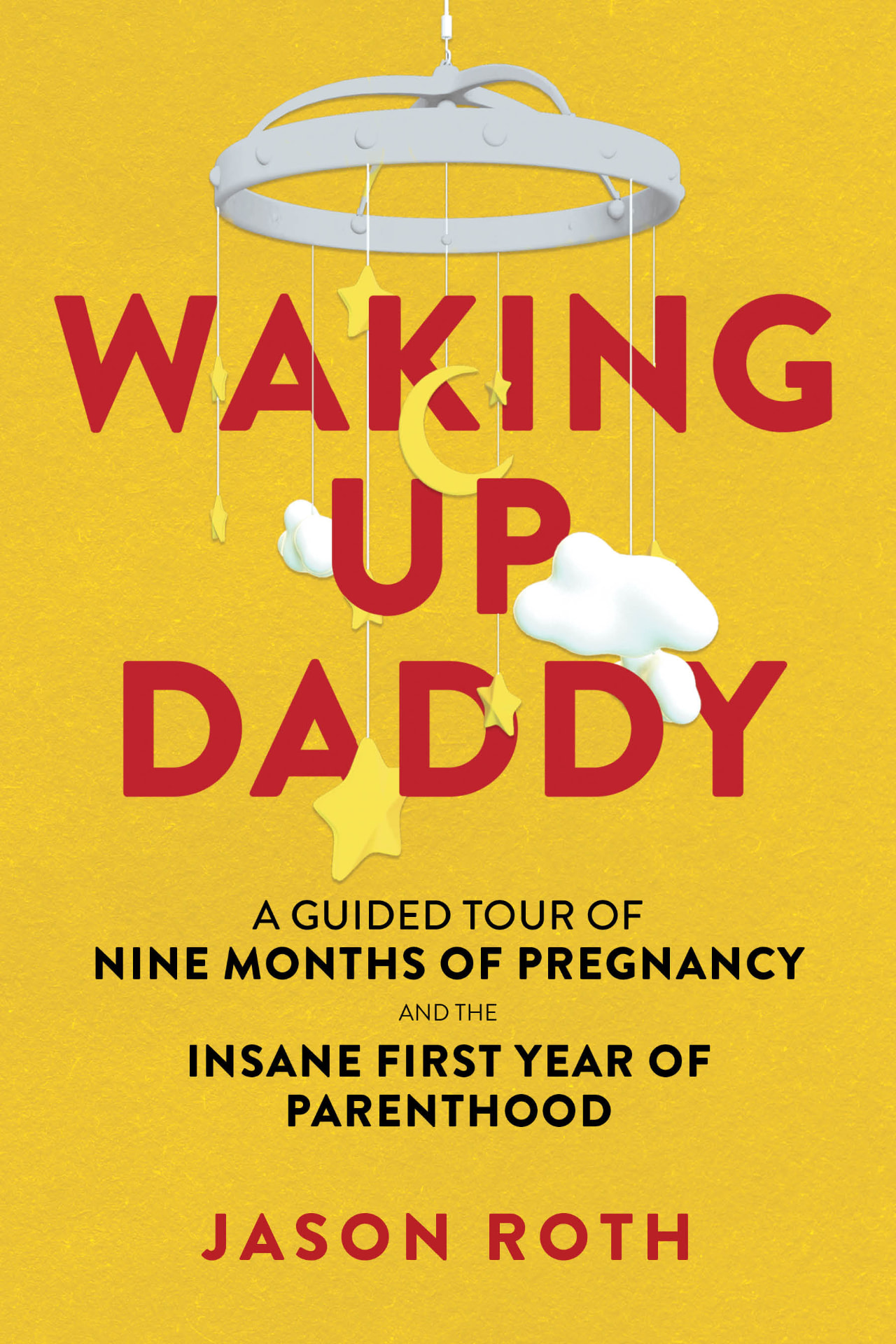
 Waking Up Daddy
Shanghaied
(Conception +5 Weeks)
I learned my wife was pregnant, if you can call it that, in the city of Shanghai. We were on a February vacation, still sore from having hiked up the Great Wall days before in Beijing. At the moment, I was sitting on a bed in the hotel room, waiting for my wife to get ready to explore the city. From the bathroom, she called out to me.
“Babe? I think I’m pregnant.”
Huh?
“Um. You think you’re pregnant?”
Trust me, I was trying to process the information. My mind flashes to the pregnancy tests she had used before. Those things might as well display the words “Congratulations, you’re pregnant!,” with corresponding instructions that the message is completely invalidated if the words are a particular shade of grey. At which point, you feel like you either need to gather paint swatches or disassemble the pregnancy kit and see if a wire is loose. Hasn’t anyone considered some sort of feature that converts the half-assed “maybe you’re pregnant, maybe you’re not” message into one that’s actually fit for human consumption?
This particular pregnancy test reading was different, though. Same doubt, different result. It turns out that Karen had brought with her a new pregnancy test that she had never used before. She came out of the bathroom to show me the reading.
Clear as day, the device had a “plus” sign on it. From the sound of that, you’d think “positive is positive” and wonder what the confusion is about. Well, I’d agree, except that one of the two lines making up this plus sign was half as dark as the other line. It appeared faint enough that I know some asshole in a white lab coat had been standing with a beaker in one hand and a prototype of this pregnancy test in the other and thinking, “Looks good enough to me. Let’s get it to marketing.” Prick.
I wanted to be excited. But I also wanted to reserve my excitement for something to be excited about. Otherwise, how exactly should I be mentally processing this celebration? “Hooray, you might be pregnant. So you might be able to join me in finishing this bottle of Champagne. Which might not be so good for our future kid, but then again, we might not really have anything to celebrate right now.”
I asked my wife, wishfully, whether she had brought the instructions for the pregnancy test from home. The instructions, it turned out, were safely located in the bathroom cabinet at home back in the US. Based on the ambiguity we were confronted with, we could have easily picked one up at a local Chinese pharmacy and achieved similar results. The whole idea of being in China and trying to make sense of a pregnancy test that looked like it was written in Chinese was precious. And so, while on the other side of the world, I discovered that you can, in fact, be a little bit pregnant.
While I remained in a state of “maybe she’s pregnant, maybe she’s not,” my wife gradually became more and more certain that she was pregnant. “More and more pregnant,” if you will. No information was learned over the next few days, mind you, she “just knew it.” This process of “just knowing,” as far as I could tell, was either due to our proximity to chemical exhaust fumes from Chinese factories or due to my wife realizing that she had no reason to be doubtful to begin with. (Feel free to insert “a mother’s intuition,” if you are so inclined.) Maybe the only reason she doubted it was because after about two years of getting perfectly accustomed to seeing negatives, this test just didn’t look right. The certainty she was gaining over the next few days was really her shock of seeing the positive result diminishing.
I, on the other hand, would postpone my own complete epistemological readjustment until we got home. The fortunate thing was that I wasn’t the one who would have to curb his intake of Tsingtaos and Singapore slings. Any baby or non-baby would be perfectly healthy regardless of my level of alcohol consumption.
Telling the In-Laws
(Conception +7 Weeks)
Mental note: if you want to maximize the reaction you get to news of your first child, don’t tell your mother-in-law less than five minutes after she wakes up from a nap. You only get to tell someone once, so pick your opportunity better than we did. To be fair, she was sporting a happy yawn. She reveled in the news for at least thirty seconds before uttering the words “you should.” Perhaps imagining her daughter engaging in such pastimes as street fights and heroin binges, she reminded her that she’d need to take care of herself during pregnancy.
My mother-in-law had a look of happiness but not of surprise. As I had been aware for some time, my wife let her know we were “trying” to keep her mother from asking if we were planning on having a baby every five minutes. The repeated questioning wouldn’t have bothered me because it would’ve been done in Chinese, but it saved my wife some frustration. Incidentally, that word “trying” has got to rank up there with phrases like “powder room,” “overactive bladder,” and “jock itch” in terms of its literal meaning versus the genteel-as-hell, floral-designed packaging used to convey it. (“Yes, for the third time, he’s fucking me bareback, Ma. Will you leave me alone already?”)
I knew my mother-in-law was happier than she was letting on. The real entertainment would be provided later in the evening.
We went out to dinner that night to a Chinese restaurant, along with my wife’s sister, her husband, and their daughter. During a well-chosen lull in conversation, my wife made the announcement. Short and sweet, as she said it earlier that evening and would do later with others: “I’m pregnant.”
Our niece glowed instantly and immediately declared that she expected us to provide her with a female playmate: “I hope it’s a girl!” (Sorry, my work was done here. It was up to the universe at this point.) The adult reactions came next, along with a few minutes of making inferences about life for the two of us for the next few months.
Then, between bites of braised tofu and sautéed pea shoots, it occurred to my mother-in-law what year we were living in, and would be, at the time of the baby’s birth.
“It’s the year of the rabbit. That’s good. It’s good it won’t be a snake. Snakes are lazy.”
Just as I was trying to compute why the laziness stereotype wouldn’t be reserved for the year of the cat, over on my right, my sister-in-law was apparently not taking this comment well.
“Mom! You know he’s a snake!”
Oops, this is awkward. Guess which astrological species my brother-in-law is?
For a tense, partly grumbling but mostly silent ten minutes, I felt I was beginning to side with my sister-in-law. After all, if you’re going to treat this stuff seriously enough to declare somebody as possessing virtues due to the year they were born in, you really ought to be cognizant of all the applicable flaws as well. And, therefore, you ought to be mindful of who in your midst is which animal and therefore do your best not to broadcast all their birth-animal-associated character flaws to everyone at the table. Indeed, the evening’s friction resulted not from disagreement about the truth or falsehood of snakes being lazy, just in the inappropriateness of inborn laziness as dinner conversation.
Upon further research, I became concerned that rabbits are born blind and hairless. But I also learned that Chinese astrology fails to distinguish between rabbits and hares, which are born sighted and hairy, so there was little need to panic. I took my research and planned to print up a provocative but astrologically accurate onesie for the kid:
Proud to be a rabbit.
We’re pessimistic, stubborn, self-indulgent, insecure,
and afraid of change.
Got a problem with that?
Ten Things Men Think They Know About Newborns
From Part 2: After Baby
1. When you wake up to feed a newborn at 3:00 a.m., they’ll go right back to sleep.
It’s not the 3:00 a.m. feedings that are so bad. It’s the 4:00 a.m. “still won’t fucking stop crying” that gets on the nerves. Fortunately, the individual in your household with the lactating breasts will likely be the one getting up for these moments of joy.
2. Babies are awkward to hold.
This is true about other people’s babies, the ones you’re worried about dropping. But there’s something about having your own baby in your arms that makes you forget they break when you drop them; it’s probably the fact that nothing in the world could ever make you drop your baby. Knowing your baby is secure in this way gives you the confidence to hold her, though it does take a little practice to maneuver the baby around in your hands while keeping the head supported. Babies typically fail to see the irony in screaming to be held while you’re trying to get their food ready, so you will teach yourself the more practical one-handed “football hold” in no time.
3. You should feel guilty about not being the one who wakes up to change and feed your baby.
Even if your wife is pumping (i.e., extracting milk via a motorized vacuum pump, not unlike something you may have seen on sale in certain red-light district establishments), she is going to have to wake up regularly to feed the baby. You getting up solely to change the diaper will be a noble act of stupidity. If the two of you are feeding your baby with formula alone and your wife is not pumping, then I suggest you use the excuse that your wife can nap during the day and tuck yourself back in. (Note, however, that this only works while your wife is on maternity leave and also doesn’t preclude you from using your baby as an excuse for your own napping at work.)
4. A newborn will poop all day long.
Some newborns won’t poop for days. Ours regularly went for stretches of three or four. And even though your first thought will be that your baby is constipated, this is very common. Tip: if the poop is soft rather than hard, the baby isn’t constipated. Unfortunately, this tip only helps once you no longer have reason to worry. (Wet diapers are another story. Even a halfday dry spell is worth a call to the doctor.)
5. The ass faces backward to keep feces from entering any nearby front-facing orifices.
That may or may not have been Mother Nature’s intent, but she definitely won’t be able to claim it as one of her crowning achievements. Be prepared to use your finger in ways you may not have expected to in conjunction with a naked baby.
6. You won’t use the word “poop” because you’re a man.
There’s something a tad callous about looking into the face of a newborn and asking her, “Did you just take a big fucking dump? Did my little girl just shit herself?” Once you realize you’ll need to downgrade your level of profanity, you will inevitably find yourself at “poop.”
7. Changing diapers is hard.
It can be a dirty job, sure, but modern engineering has advanced disposable diaper technology so much that they’ve moved on to creating them for adults. Look for the diapers with the “wetness indicator” on the outside of the diaper, and you’ll see what I mean. The hardest thing to get used to is the crying and screaming while you’re changing them, indicating to you that you could be, perhaps, inflicting excruciating pain upon them. But even this takes less than twenty-four hours to be completely comfortable with.
8. You’ll have to humiliate yourself by talking like an effeminate buffoon whenever you’re in the presence of both your baby and a fellow adult.
This is incorrect. There will be no humiliation because you will simply be unaware of what an effeminate buffoon you sound like. Babies in general might not have this kind of effect on your speech, but your own baby will.
9. There’s no way your baby is crying because he’s hungry, you just fed him two hours ago.
Hunger is reason #1 for crying, and whatever schedule or guidelines you’ve heard will not yet have made its way into your baby’s prefrontal cortex. These little big-mouths always get hungrier faster than you think. In general, whatever the reason is you think your baby is crying, you’re wrong.
10. Your newborn will smile when she sees you, look forward to getting a bath, and understand what you mean when you say she can stop crying now because you’re in the process of heating up a bottle.
Newborns have needs. That’s all they have. You are either satisfying these needs, trying but failing to satisfy these needs, or waiting for the chance to try again. And don’t worry, you won’t have to wait long.
Introduction
(Spoiler Alert: We Survived)
When I think “parenting book,” I think the dishing out of advice. It turns out, though, that as much as new parents can benefit from advice, what they really need is a respite from it.
I didn’t write this book in order to give advice, but I also didn’t write it solely for new parents. I wrote it to document what actually happened, physically and mentally, during the nine-month lead-up to childbirth and the full year that follows. Of course, you could write this book too. It’ll be both identical in some ways and radically different in others. You may or may not have Chinese in-laws, for instance. But it’s very likely you do have a family member who will forecast your child’s gender based on a belief in a convoluted set of rules that typically lands people in padded rooms. Likewise, you may be a parent who’s already gone through all of this. Whether or not you panicked that your child might be a cousin of the Elephant Man after seeing the 3D ultrasound (more on that later), you’ll surely recognize the constant, never-ending worry that every single aspect of pregnancy, birth, and childcare can, and will, go wrong. I’m just here to say that it actually doesn’t. Some of the shit you do actually works.
To clarify: by “works,” what I really mean is “doesn’t kill your kid.” Sometimes, you know parenting stuff works when, for example, feces doesn’t leak through a onesie onto a car seat. Other times, you have no idea if your parenting technique “worked” or if your child will prove it absolutely didn’t work when they commit their first first-degree felony at age eighteen and personally credit you in the handwritten confession.
I started this book on the day my wife “announced” she was pregnant. (I put that word in quotes because it wasn’t so much an announcement as a question. I’ll explain later.) I wanted to document what actually happens and what kind of insane thoughts go through a parent’s head throughout pregnancy. And to do it in a way that relates to more people than two particular expecting parents. I soon decided that it might also be interesting to see how many of those prescient and/or insane thoughts would align with what the first year of parenthood is actually like. So, I kept writing, documenting, and philosophizing for twelve months after birth as well.
You’ll note that the format of the book consists of anecdotes, some philosophizing, then more anecdotes, more or less in chronological order. Hopefully both the anecdotes and the philosophizing get more informed and erudite as time passes, but I’ll let you be the judge.
As to the subject of the passage of time, please allow me to give one piece of advice to future parents. Each of the moments described, pondered, and microanalyzed in this book is the actual stuff that makes up becoming, and being, a parent. The biggest mistake an expecting or current parent can make is to think of these moments as part of a holding pattern for some future state of parenthood. These are the moments of a parent’s life. Just as life is not some precursor to a better, “ideal” life, nor should your first awkward attempt to diaper a baby be glossed over until you graduate as a professional. Never think of any aspect of parenthood as something you’re just trying to “get through.” This is it. This is what it’s all about. That baby in your own or your wife’s stomach—or later, in your arms—should never be seen as a stepping stone. It’s a life, and having the unfathomably, absurdly lucky opportunity to observe and take part in its journey is something one surely ought not to piss away.
As this section’s title reveals, my wife and I did, in fact, survive a year of parenthood. How, and whether we regret it (either the parenthood or the survival), will be answered in the pages ahead. I’m looking forward to telling you about it.